A1Z26 vs A0Z25: What’s the Difference?
A clear comparison of the A1Z26 and A0Z25 letter-to-number systems.
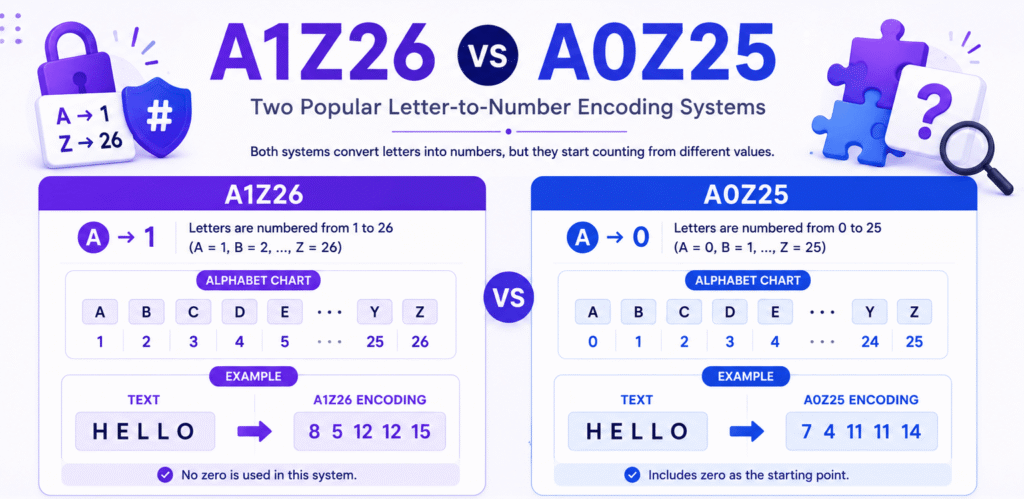
A1Z26 vs A0Z25 are two different letter-to-number systems that map alphabet characters to numerical values using different starting points.
A1Z26: counting from one
In A1Z26, A equals 1 and counting continues normally through Z, which equals 26. This matches how most people naturally count a letter’s position in the alphabet.
A0Z25: counting from zero
A0Z25 shifts everything down by one, so A equals 0 and Z equals 25. This mirrors how many programming languages index arrays starting at zero, which is why developers sometimes prefer it.
Side-by-side comparison
| Word | A1Z26 | A0Z25 |
|---|---|---|
| BAD | 2-1-4 | 1-0-3 |
| CAT | 3-1-20 | 2-0-19 |
| HELLO | 8-5-12-12-15 | 7-4-11-11-14 |
Every value in A0Z25 is exactly one less than its A1Z26 counterpart. See more side-by-side examples across different words.
When to use each one
Use A1Z26 for general puzzles, classroom lessons, and anything meant to feel intuitive. Use A0Z25 when working alongside code that indexes from zero, or when you want a puzzle variant that trips up solvers expecting the standard mapping.
You can switch between both modes, plus reverse alphabet and ASCII, any time in the main converter, or browse the full alphabet chart.
Ready to convert your own text?
Open the free converter and try A1Z26, A0Z25, reverse alphabet, or ASCII in seconds.
Open the Converter