What Is the A1Z26 Cipher? A Simple Explanation
Learn what the A1Z26 cipher is, how it works, and why it remains a widely used letter-to-number system.
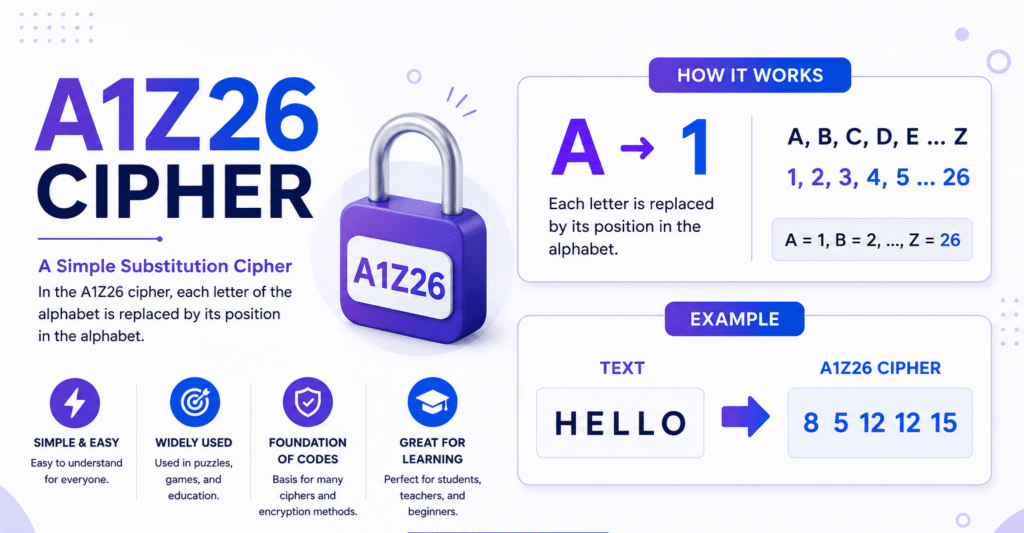
The A1Z26 cipher is one of the oldest and simplest substitution ciphers in cryptography. It replaces every letter of a message with a number based on its position in the alphabet. A becomes 1, B becomes 2, and so on through Z, which becomes 26.
Why it’s called A1Z26
The name describes its two endpoints: A=1 and Z=26. Unlike more complex ciphers, A1Z26 doesn’t require a secret key, the rule is always the same, which makes it ideal for anyone learning to convert letters to numbers for the first time.
How encoding works
Replace every letter with its alphabet position and separate the numbers with a hyphen. The word CIPHER becomes 3-9-16-8-5-18. Spaces between words are usually preserved so multi-word phrases stay readable. See more worked examples.
How decoding works
Decoding reverses the process: split the numbers apart, then match each one back to its letter using the same A=1 through Z=26 rule. Because there’s no hidden key, decoding is just as fast as encoding.
A1Z26 Converter and Decoder
An A1Z26 converter changes letters into numbers by using alphabet positions. For example, A becomes 1, B becomes 2, and Z becomes 26. An A1Z26 decoder does the opposite by converting numbers back into letters. These tools are commonly used for puzzles, learning activities, and simple code-breaking exercises.
A1Z26 Chart
Iske neeche table add karo:
| Letter | Number | Letter | Number |
|---|---|---|---|
| A | 1 | N | 14 |
| B | 2 | O | 15 |
| C | 3 | P | 16 |
| D | 4 | Q | 17 |
| E | 5 | R | 18 |
| F | 6 | S | 19 |
| G | 7 | T | 20 |
| H | 8 | U | 21 |
| I | 9 | V | 22 |
| J | 10 | W | 23 |
| K | 11 | X | 24 |
| L | 12 | Y | 25 |
| M | 13 | Z | 26 |
A1Z26 vs other letter-number systems
A1Z26 isn’t the only way to map letters to numbers. Some systems start counting from zero instead of one. See our A1Z26 vs A0Z25 comparison. Others use raw ASCII character codes instead of alphabet position entirely.
A1Z26 vs ASCII Values
A1Z26 and ASCII are two different ways to represent letters with numbers. A1Z26 uses alphabet positions where A equals 1 and Z equals 26. ASCII uses numerical codes assigned to characters by computers. A1Z26 is mainly used for puzzles and simple encoding, while ASCII is commonly used in programming and digital systems.
Common Uses of A1Z26 Cipher- Classroom cryptography lessons introducing basic code-breaking
- Escape room and treasure hunt puzzles
- Casual numerology explorations of names and words
- Simple secret messages between friends
Ready to try it? Use the free converter to encode any message instantly, or check the complete alphabet chart.
Frequently Asked Questions
What does A1Z26 mean?
A1Z26 means the alphabet is converted into numbers from 1 to 26, where A is 1 and Z is 26.
Is A1Z26 a real cipher?
Yes, A1Z26 is a simple substitution cipher that replaces letters with their alphabet positions.
How do I decode A1Z26 numbers?
To decode A1Z26, match each number with its corresponding alphabet position.
What is an A1Z26 converter?
An A1Z26 converter is a tool that changes letters into numbers or numbers back into letters using the A1Z26 system.
Can A1Z26 convert numbers back to letters?
Yes, A1Z26 can decode numbers back into letters by matching each number with its alphabet position.
Ready to convert your own text?
Open the free converter and try A1Z26, A0Z25, reverse alphabet, or ASCII in seconds.
Open the Converter