ASCII Values for Letters and Characters Explained
Understand ASCII values for uppercase and lowercase letters and how they differ from A1Z26.
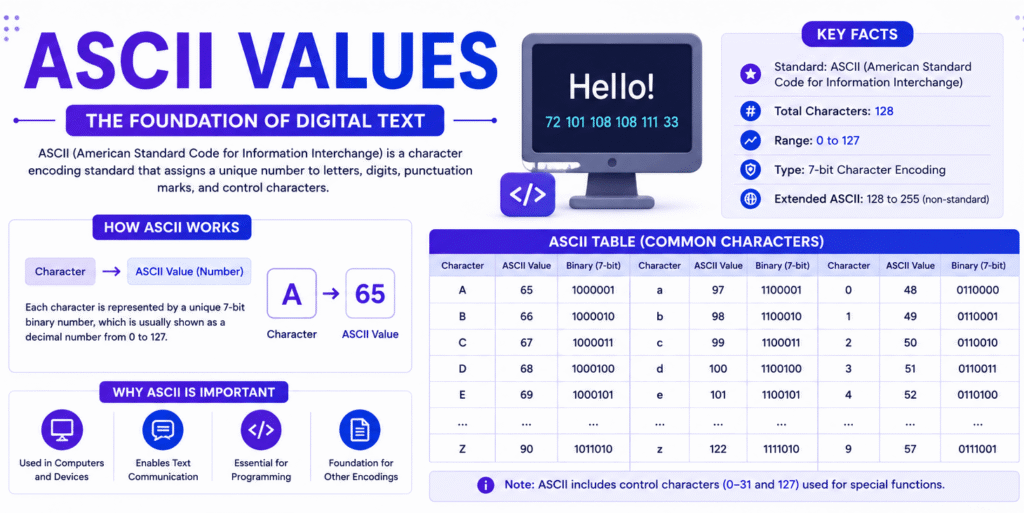
ASCII values for letters are numerical codes used by computers to represent characters. Each letter, number, and symbol has a unique ASCII value. For example, uppercase A has an ASCII value of 65, while lowercase a has a value of 97.
How ASCII differs from A1Z26
While the A1Z26 alphabet cipher starts counting at 1 for A, our A1Z26 converter uses alphabet positions to map letters into numbers. ASCII assigns uppercase A the value 65 and lowercase a the value 97, because ASCII covers punctuation, digits, and control characters too, not just the 26 letters.
Uppercase letter values
Uppercase letters run from 65 (A) through 90 (Z) in consecutive order, so each letter’s ASCII value is exactly 64 higher than its A1Z26 position. See the A1Z26 conversion guide for a refresher on that base method.
Lowercase letter values
Lowercase letters run from 97 (a) through 122 (z), 32 higher than the matching uppercase letter, a detail programmers rely on constantly when converting text case in code.
Why ASCII is case-sensitive
Unlike A1Z26, where “Hello” and “HELLO” convert identically, ASCII mode treats uppercase and lowercase letters as different values, since computers distinguish between the two. See the A1Z26 vs A0Z25 comparison for how those two systems handle case instead.
Try it yourself
Switch the main converter to ASCII mode to see the real character codes your browser and computer use behind the scenes, or check the full alphabet reference chart. For puzzle ideas using ASCII values, see how alphabet numbers work in puzzles.
Ready to convert your own text?
Open the free converter and try A1Z26, A0Z25, reverse alphabet, or ASCII in seconds.
Open the Converter